

Your central vision handles the fine detail, from the text on your phone to a friend’s face across a room. Macular degeneration chips away at that ability, often slowly enough that you adjust without realizing anything has changed. Both forms damage the same small patch of tissue, which is why people mix them up.
Dry macular degeneration develops gradually as protein deposits collect under the retina, while wet macular degeneration moves quickly when abnormal blood vessels leak fluid or blood. Which one you have shapes how often you should book a comprehensive eye exam.
What Macular Degeneration Means for Your Vision
The macula sits at the centre of your retina and takes care of sharp, straight-ahead vision. Small piece of tissue, big job.
Age-related macular degeneration damages it. Your peripheral vision usually keeps working, so you may still pick up movement and shapes at the edges while faces and printed words get harder to make out. Age is a major risk factor, and the disease turns up most often in adults past 50.
Dry Macular Degeneration Explained
Roughly 9 in 10 cases are dry macular degeneration. Yellowish deposits called drusen build up under the retina, and the condition works through early, intermediate, and late stages, usually over years.
Plenty of people notice nothing early on. The signs that do show up are easy to write off as tired eyes or poor lighting:
- Slight blurriness in the middle of your vision
- Trouble adjusting when you step into a dim restaurant
- Straight lines, like door frames, that start to look wavy
- Colours that seem duller than they used to
Mention any of these to your optometrist, even if they come and go.
Wet Macular Degeneration Explained
Wet macular degeneration accounts for about 10% of cases and tends to be the more serious of the two. Abnormal blood vessels grow beneath the retina and leak, and that fluid swells the macula and distorts what you see.
Changes can arrive over days or weeks instead of years. Call your optometrist right away if a dark or blank patch appears in the centre of your sight.
How Dry Can Turn Into Wet
Dry macular degeneration can develop into the wet form at any point, with no warning stage in between. Yearly monitoring matters for that reason, even when your vision feels fine.
Use an Amsler grid at home so you can notice new distortion easier, since you’re checking against the same pattern every time. Cover one eye, focus on the centre dot, and flag anything that looks bent or missing.
Test each eye on its own. Your stronger eye tends to compensate for the weaker one during everyday tasks, and that’s how central changes slip by for months.
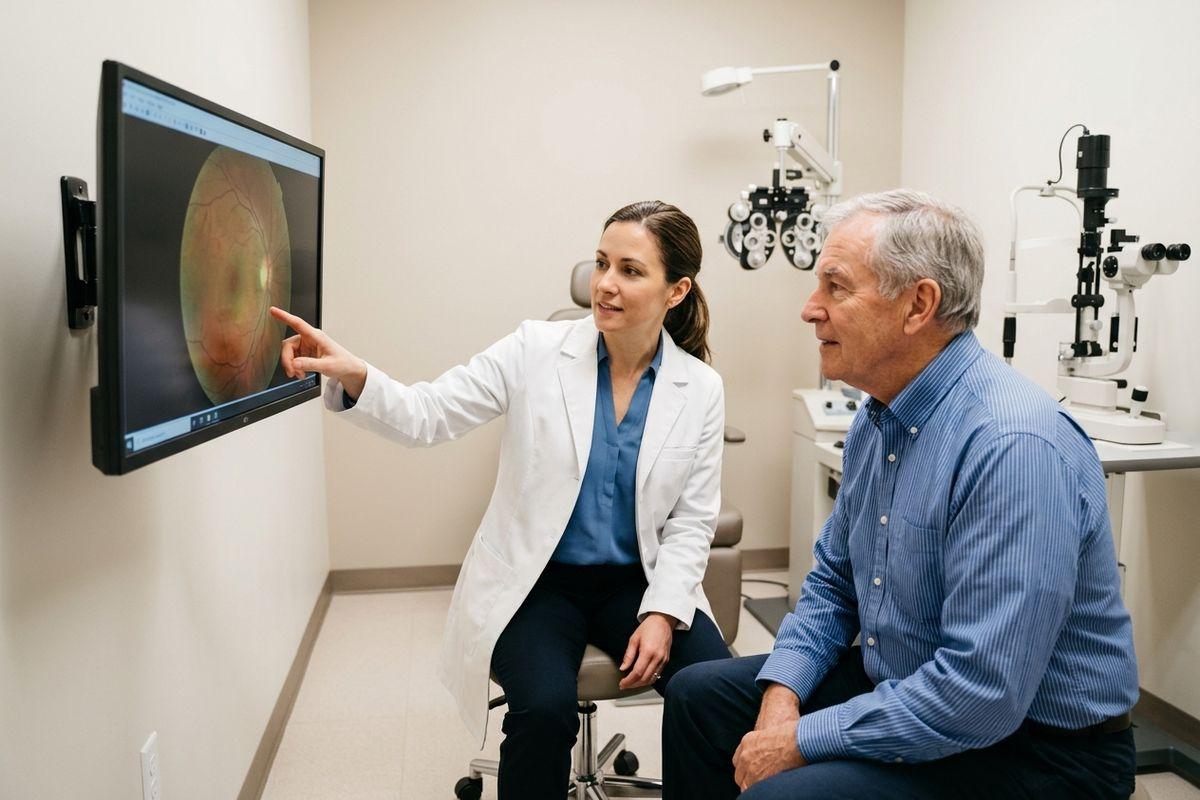
How Optometrists Detect and Treat Both Types
Testing goes well beyond reading letters off a chart. Here are a few of the tools your optometrist may reach for:
- AdaptDx testing, which measures how long your eyes take to adjust to darkness and can reveal changes before you notice symptoms
- OCT scans that image the retina layer by layer
- Optomap imaging for a wide view of the back of the eye
- A dilated exam, where drops widen your pupils so more of the retina is visible
What Treatment Can Look Like
Treatment depends on the type and the stage, and your optometrist coordinates with a retinal specialist once injections come into the picture. Options include:
- Anti-VEGF injections for the wet form, which reduce leaking from those fragile blood vessels
- Antioxidant supplements based on the AREDS2 formula, which may slow progression in intermediate dry AMD
- Low vision aids such as magnifiers and brighter task lighting for reading and cooking
Habits That Support Your Macula
Daily choices carry real weight here. Start with a yearly exam, then look at what else you can adjust:
- Quit smoking, which raises your risk of developing AMD
- Wear UV-blocking sunglasses outdoors in every season
- Eat leafy greens like spinach and kale for lutein and zeaxanthin
- Add fish a couple of times a week for omega-3s
- Manage your blood pressure, since cardiovascular health ties into AMD risk
None of this reverses damage that’s already there. It may slow things down, and it gives your eyes a better foundation to work from.
Check In on Your Macula Every Year
Macular degeneration rarely announces itself. Early stages come with few symptoms you’d notice on your own, so a yearly exam gives your optometrist a baseline to compare against and a way to track small changes over time.
The team at See Eye Clinic uses AdaptDx testing and detailed retinal imaging to monitor macular health for adults and seniors. Book your comprehensive eye exam and find out where your vision stands today.